Short answer
A padel court measures 20 × 10 m with a 0.5% tolerance. The net sits in the middle, 0.88 m high at the centre and 0.92 m at the posts. The service lines are 6.95 m from the net, the back walls have 3 m of solid wall and 1 m of mesh. There must be at least 6 m of clear height above the court.
Every padel player knows the court is "ten by twenty". But where exactly is the service line, how high does the glass go and how wide can the doors be? Here are the numbers the FIP gives in the rules in force since 1 January 2026, including the ball and the racket. For what counts on the court, see padel rules.
Court and lines
| Element | Dimension |
|---|---|
| Court (internal measurements) | 10 m wide, 20 m long, 0.5% tolerance |
| Net | divides the court into halves, so at 10 m |
| Service line | parallel to the net, 6.95 m from it on each side |
| Centre service line | from the net to the service line, extending past it by at least 20 cm |
| Line width | 5 cm, ideally white or black |
| Clear height | min. 6 m, 8 m recommended for new courts |
The centre line splits the area between the net and the service line into two service boxes. Their width of 5 m is not stated as a number in the rules; it follows from half the court width. Lines belong to the box they bound, so a serve that lands on the line is good (7.1 c).
Net
The net is 10 m long. It measures 0.88 m at the centre and 0.92 m at the posts, with a 5 mm tolerance. The supporting cable is at most 1 cm in diameter, the posts are at most 1.05 m high and their outer face sits exactly on the side boundary of the court. Along the top runs a white band 5.0 to 6.3 cm wide.
Walls and mesh
The back walls total 4 m: the lower 3 m of wall (glass or a solid material) with 1 m of metal mesh above. The wall can be transparent or opaque, but it must be hard, smooth and give an even bounce.
For the side walls the FIP allows two variants:
- Variant 1, stepped: at both ends of the court the first step is 3 m high and 2 m long, the second step 2 m high and 2 m long. Mesh fills in the rest, reaching 3 m in the middle 6 m and 4 m at both ends.
- Variant 2, glazed: at both ends the wall is 3 m high and 4 m long, with no step. Mesh completes the enclosure to a height of 4 m in the outer 2 m.
The mesh is welded with diamond-shaped openings, a diagonal of 5 to 7.08 cm and wire at most 4 mm thick (2 to 3 mm recommended). What you may play off the glass and off the mesh is covered in the article on glass, mesh and net.
Doors
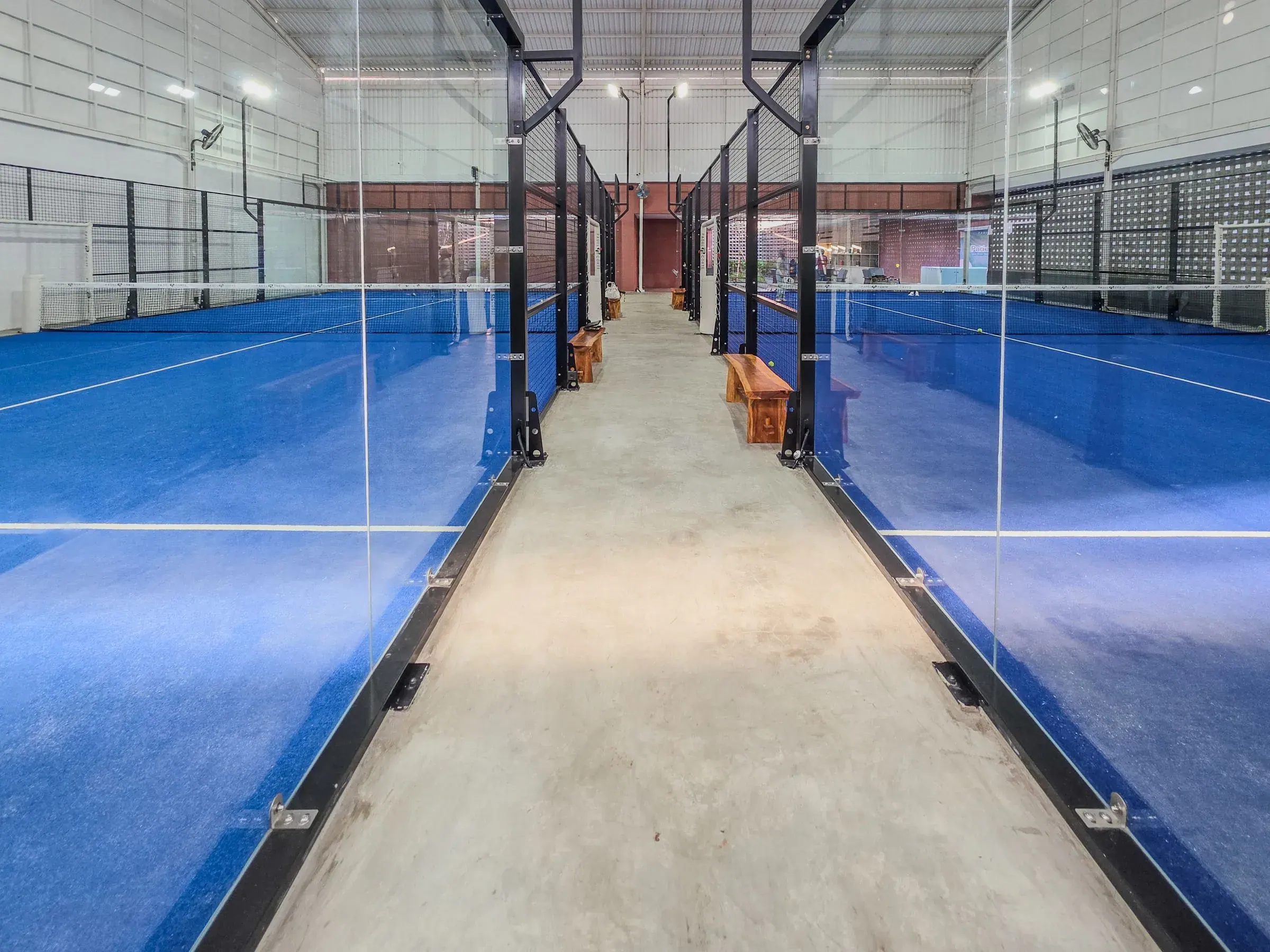
Entrances can be on both sides or just one, always symmetrical to the centre of the court, and there can be one or two per side:
- one entrance per side: at least 1.05 × 2.00 m, at most 2.20 × 2.20 m;
- two entrances per side: at least 0.72 × 2.00 m, at most 1.10 × 2.20 m.
Where exactly along the side wall the doors stand, the text of the rules does not say.
Safety zone and lights
For the ball to be playable outside the court, each side needs an obstacle-free space outside that is at least 3 m wide (4 m recommended) and 4 m long, with a height of at least 3 m. The entrance must be padded on the sides, at the top and on the post by the net with at least 2 cm of material such as rubber or neoprene. Lighting poles stand outside the court. If they intrude into the safety zone, play outside the court is not allowed. The lower edge of the floodlights is at least 6 m above the ground, 8 m recommended for new courts. When you may run out, see the article on playing outside the court.
Surface
Concrete, synthetic or artificial grass, in green, blue or terracotta. Unevenness must not exceed 3 mm over 3 m.
Ball and racket
| Element | Value |
|---|---|
| Ball diameter | 6.35 to 6.77 cm |
| Ball weight | 56.0 to 59.4 g |
| Ball bounce | 135 to 145 cm when dropped from 2.54 m |
| Bounce above 1,000 m altitude | 121.92 to 135 cm |
| Racket length | max. 45.5 cm |
| Racket width | max. 26 cm |
| Racket thickness | max. 38 mm |
| Holes in the racket | 9 to 13 mm |
| Wrist strap | compulsory, max. 35 cm |
Timings
20 seconds between points, 90 seconds at the change of ends, 120 seconds between sets. There is no rest after the first game of a set or during the tiebreak; the change of ends in the tiebreak takes 20 seconds. The pre-match warm-up lasts 3 minutes (rules 2.2 to 2.10).
Did you know?
- The net height at the posts, 0.92 m, is also the level above which the door post is a neutral zone for all four players (13.1 b).
- The rules never state the width of the service box. You have to work out the five metres yourself.
- An outdoor court should have its long axis running north–south. It is a recommendation, not an obligation.
- Padel is scored almost like tennis; only the court looks completely different. For how it works without walls, see tennis rules.
Frequently asked questions
How far is the service line from the net in padel?
6.95 m on each side. That leaves 3.05 m to the back wall.
How high is a padel net?
0.88 m at the centre and 0.92 m at the posts, with a 5 mm tolerance. The posts may be at most 1.05 m high.
How high are the glass and the mesh on the back wall?
The back wall has 3 m of solid wall or glass with 1 m of mesh above it, 4 m in total.
Does a padel court need doors on both sides?
No. Entrances can be on both sides or just one, always symmetrical to the centre. For play outside the court, though, the rules require two entrances on each side and a clear safety zone.
DOTTA keeps score for you and calls it out loud
Win the rally, click the remote on your racket. The app tracks points, games and ends, and announces the score to the whole court.