Short answer
A tennis court is 23.77 m long and 8.23 m wide for singles, 10.97 m for doubles. The service line is 6.40 m from the net. The net is 0.914 m high at the centre and 1.07 m at the posts. Measurements are taken to the outside edge of the lines.
You take the court for granted until you need to know how far away the fence may stand, where the singles stick goes or how wide the baseline may be. All the figures below come from the ITF Rules of Tennis 2026 (rule 1 and Appendix X). Measurements are always taken to the outside edge of the lines. For how scoring works on the court, see tennis rules.
Court and lines
| Measurement | Value |
|---|---|
| Court length | 23.77 m |
| Width for singles | 8.23 m |
| Width for doubles | 10.97 m |
| Doubles alley (each side) | 1.37 m |
| Service line from the net | 6.40 m |
| Centre mark | 10 cm long |
The lines at the ends are called baselines, the lines along the sides are sidelines. The rules distinguish the singles sideline from the doubles sideline. Between them is a 1.37 m wide alley that is only used in doubles.
The service line is parallel to the net, 6.40 m from it on each side, and runs only between the singles sidelines. The centre service line bisects it and divides the area between the net and the service line into two equal service courts. From the court length it follows that each half is 11.885 m, so roughly 5.49 m remain from the baseline to the service line. Each service court is 6.40 m deep and 4.115 m wide.
In the middle of the baseline is the centre mark: 10 cm long, drawn inside the court, parallel to the sidelines.
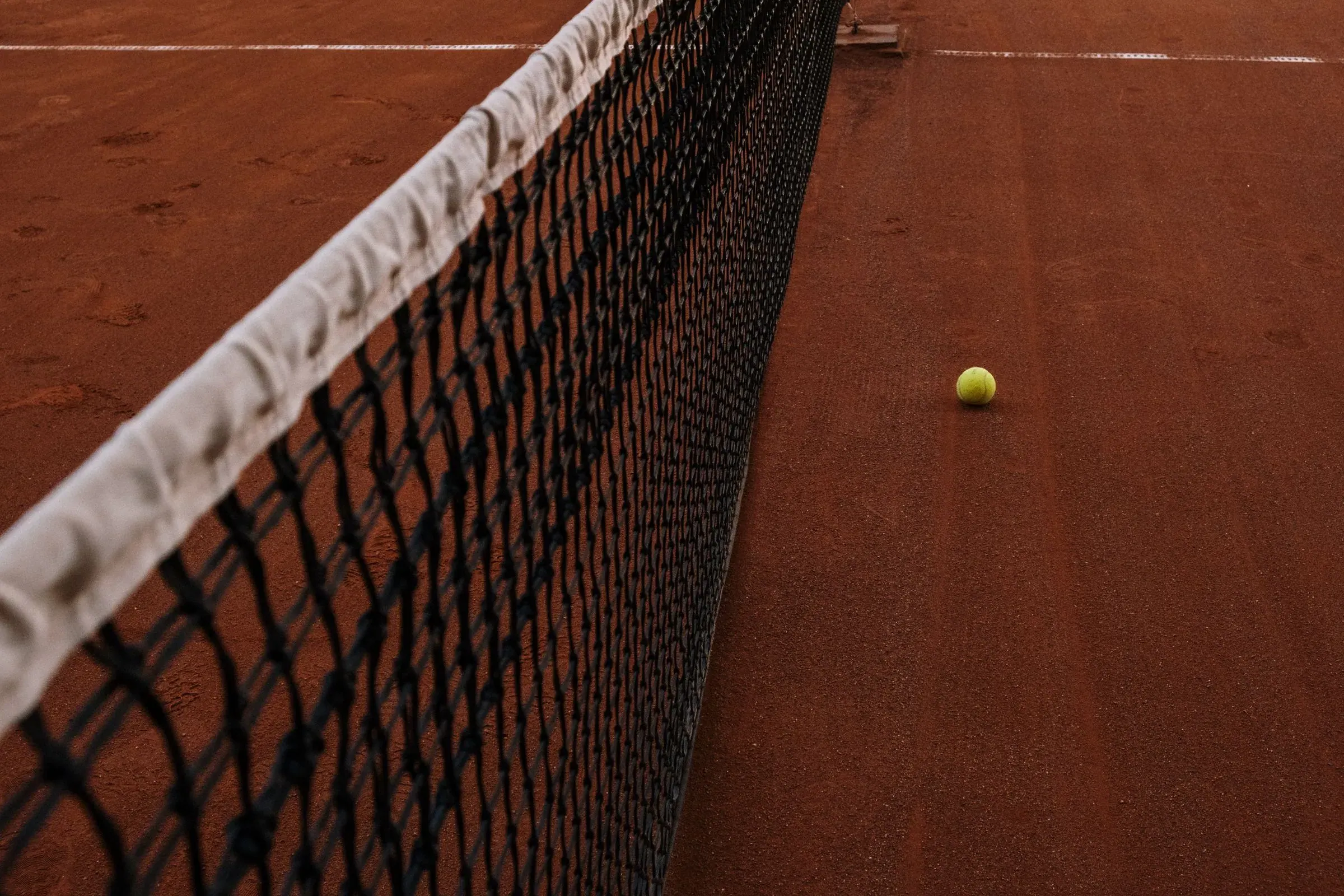
Net, posts and singles sticks
- The net is 0.914 m at the centre. It is held down by a strap at most 5 cm wide.
- At the posts and at the singles sticks it measures 1.07 m.
- The centres of the posts are 0.914 m outside the doubles court on each side. A post may be at most 15 cm square or in diameter.
- The singles sticks have their centres 0.914 m outside the singles sideline and are at most 7.5 cm square or in diameter. They are used when singles is played on a doubles net.
- Neither the posts nor the sticks may extend more than 2.5 cm above the net cord.
- The cord is at most 0.8 cm in diameter, the band along the top is 5 to 6.35 cm deep on each side, and the strap and the band are entirely white.
A singles-only net is 10 m long and its posts stand where the singles sticks would otherwise be (Appendix X). What happens when the ball hits a post or a stick is covered in Lets, the net and touches in tennis.
Line width and the space around the court
The centre service line and the centre mark are 5 cm wide. The other lines are 2.5 to 5 cm, and only the baseline may be up to 10 cm (rule 1). A ball that touches a line is in, because the line belongs to the court it bounds (rule 12).
Appendix X also recommends the clear space around the court: from the baseline to the back fence at least 6.40 m for international competitions and 5.48 m for clubs, from the sideline to the side fence 3.66 m and 3.05 m respectively. The ceiling should be at least 9 m above the net.
Did you know?
- Fences, stands, spectators, the chair umpire and ball kids in their positions are permanent fixtures under rule 2. When singles is played on a doubles net, the posts and the part of the net outside the singles sticks are permanent fixtures too.
- Only an approved player-analysis device may be attached to a net post, as a guide at most 50 cm wide, 40 cm deep and 122 cm high (rule 2, case 1).
- The net crosses the singles sideline 4.11 m from its centre and the doubles sideline 5.48 m from the centre (Appendix X).
- For children up to 10 the rules provide smaller courts (red and orange), described in Appendix VIII.
- In doubles the server may also stand behind the part of the baseline that lies between the two sidelines. In singles not (rule 18, case 1). More in Tennis doubles rules.
Frequently asked questions
How long and wide is a tennis court?
23.77 m long. 8.23 m wide for singles and 10.97 m for doubles. Measured to the outside edge of the lines (rule 1).
How high is a tennis net?
0.914 m at the centre, 1.07 m at the posts and the singles sticks (rule 1).
What are singles sticks for?
When you play singles on a doubles net, they hold the net at 1.07 m at a point 0.914 m outside the singles sideline (rule 1). They may be at most 7.5 cm square or in diameter.
How far is the service line from the net?
6.40 m on each side. A service court is therefore 6.40 m deep and 4.115 m wide.
Is a ball that touches the line in?
Yes. The line belongs to the court it bounds (rule 12).
DOTTA keeps score for you and calls it out loud
Win the rally, click the remote on your racket. The app tracks points, games and ends, and announces the score to the whole court.