Faults and Lets in Badminton: Net, Ceiling, Lines and Double Hits
Short answer
In badminton it is a fault when the shuttle lands outside the lines, fails to pass over the net, touches the ceiling, a wall, a player or their clothing, or when a player touches the net. A shuttle on the line is in. A let means the rally is replayed, and the player who served last serves again.
Most badminton rallies end clearly: the shuttle hits the floor and everyone knows who gets the point. But then comes a shuttle on the line, a touch of the net tape or a shot into the ceiling, and the discussion starts. Laws 13 to 15 have an answer for every one of those situations. Here they are in one place. For the basics of scoring, see badminton rules.
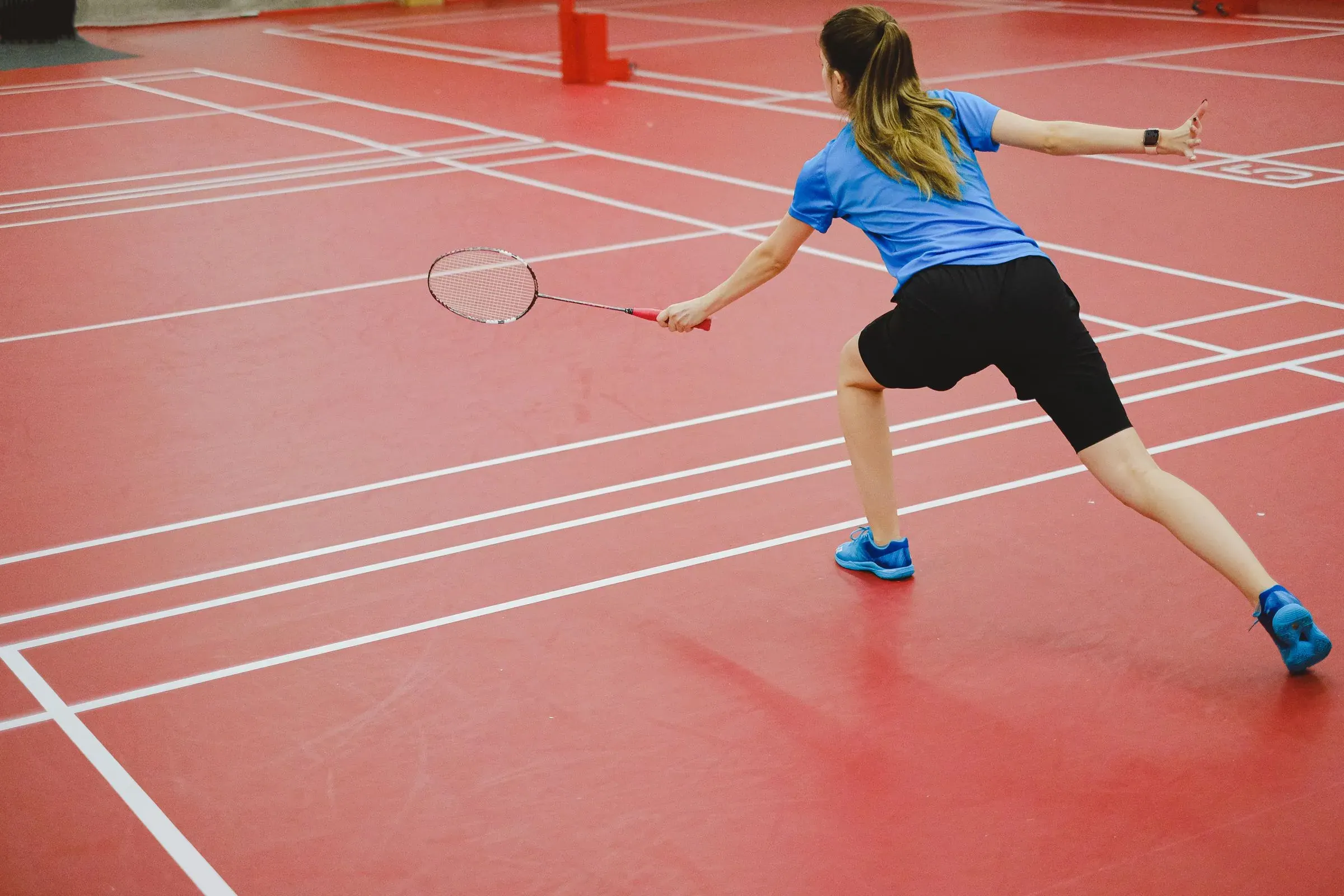
What is a fault in play
A fault ends the rally and the opponent gets the point (7.3). During play it is a fault when the shuttle:
- lands outside the lines of the court (13.3.1),
- fails to pass over the net (13.3.2),
- touches the ceiling or a side wall (13.3.3),
- touches a player or their clothing (13.3.4),
- is hit twice in succession by the same player (13.3.7).
There is an exception to the double hit: if the shuttle hits the frame and the strings in a single stroke, it is not a fault (13.3.7). Only a genuine double hit is a fault.
And watch the line. Under Law 1.3 the lines form part of the area they define. A shuttle that touches a line is therefore in. That goes for the side lines, the back boundary line and the service lines.
The net: touching, reaching over and a caught shuttle
The net is the most common source of arguments. Yet Law 13.4 is unambiguous:
- If during play you touch the net or its supports with your racket, body or clothing, it is a fault (13.4.1).
- Reaching over the net with the racket is a fault. The only exception: if you hit the shuttle on your own side, you may follow through over the net as part of the stroke (13.4.2).
- Deliberately distracting an opponent, for instance by shouting or gesturing, is a fault (13.4.5).
If the shuttle hits the net or a post and starts to fall towards the side of the player who hit it, the shuttle is not in play (15.1) and it is a fault by the player who hit it (13.3.2), so the opponent gets the point. It is also not in play once it touches the surface of the court (15.2): if it lands in the opponent's court, the side that sent it there gets the point (7.3). And finally when a fault or let occurs (15.3).
On the serve it is a fault if the shuttle is caught on the top of the net, gets stuck in it after passing over, or in doubles is hit by the receiver's partner (13.2.1 to 13.2.3). A serve that merely brushes the net and lands in the correct service court is good.
When a let is played
A let means the rally does not count and is played again. Law 14.2 lists these cases:
| Situation | Law |
|---|---|
| Serving before the receiver is ready | 14.2.1 |
| Both server and receiver fault on the serve at the same time | 14.2.2 |
| After the serve is returned, the shuttle is caught on the top of the net or stuck in it | 14.2.3 |
| The shuttle disintegrates and the base separates from the rest | 14.2.4 |
| Play is disrupted by a coach | 14.2.5 |
| A line judge is unsighted and the umpire cannot decide | 14.2.6 |
After a let, the player who served last serves again (14.3). The score does not change.
A caught shuttle has two forms. On the serve it is a fault; in play after the serve has been returned it is a let. On the serve, then, the receiver gets the point.
The receiver is considered ready as soon as they attempt to return the shuttle (9.4). So if you play the serve, you cannot then claim a let because you were not ready.
Typical situations on court
The shuttle hit the ceiling. A fault by the player who hit it (13.3.3). No let is played in that situation; the Laws have none for the ceiling.
The shuttle passed over the net and got caught on the tape. After the serve has been returned, it is a let (14.2.3). On the serve it is a fault by the server (13.2.1).
My opponent was chasing the shuttle and touched the post. A fault; Law 13.4.1 covers the net and its supports. Whether the touch was deliberate does not matter.
I smashed and my racket went over the net. If you hit the shuttle on your own side, that is fine (13.4.2). It would be a fault only if you touched the shuttle already over the opponent's half.
The shuttle landed on the back boundary line. In. The line is part of the area (1.3).
Changing ends and intervals
You change ends after the first game, after the second game if a third is to be played, and in the deciding third game when one side first reaches 11 points (8.1.1 to 8.1.3). This applies under the 2025 Laws until 3 January 2027. From 4 January 2027 the BWF has adopted a new scoring format; the details are in the article on the 3x15 format.
The interval between games lasts at most 120 seconds, and in the middle of each game, when the leading side reaches 11 points, you get 60 seconds (16.2.1, 16.2.2).
Did you know?
- A feather shuttle has 16 feathers 62 to 70 mm long and weighs 4.74 to 5.50 g (2.2.1, 2.2.2, 2.2.6).
- Shuttle speed is tested with a full underhand stroke from the back boundary line. A correct shuttle lands 530 to 990 mm short of the opposite back boundary line (3.1, 3.2).
- A toss is held before the match. The winner chooses to serve, to receive or an end; the loser gets the remaining choice (6.1, 6.2).
- The complete serving rules, including the 1.15 m limit, are in the article on the badminton serve.
Frequently asked questions
Is touching the net always a fault in badminton?
Yes, if you do it during play with your racket, body or clothing (13.4.1). The Laws do not distinguish between a deliberate and an accidental touch.
What if the shuttle touches the ceiling?
It is a fault by the player who hit the shuttle (13.3.3). No let is played in that situation.
Who serves after a let?
The player who served last (14.3). The score stays the same.
Can I follow through with a smash over my opponent's side of the net?
You can, as long as you hit the shuttle on your own side. Law 13.4.2 allows the follow-through over the net.
Is a shuttle on the line in?
Yes. All lines form part of the area they define (1.3).
DOTTA keeps score for you and calls it out loud
Win the rally, click the remote on your racket. The app tracks points, games and ends, and announces the score to the whole court.