Is there momentum in tennis and padel? What the data says about streaks
Short answer
A little, yes. A 2001 study by Klaassen and Magnus found that winning a point slightly raises the chance of winning the next one. The effect is small, and a model with independent points still works as a good estimate. Luck and the alternating serve explain most streaks.
You are down 1-4, then you win three games in a row and it feels like the match has turned. Your opponent supposedly lost their head, you "found your rhythm". Is that real momentum, or did chance just line up? What does the data say?

What the Wimbledon study found
The best-known answer is a 2001 paper by Franse Klaassen and Jan Magnus in the *Journal of the American Statistical Association* (Are Points in Tennis Independent and Identically Distributed?). They used points from men's and women's singles at Wimbledon from 1992 to 1995, almost 90,000 points in total. An earlier 1998 version of the study gives exactly 88,883 points from 481 matches.
They looked at the point the server wins. If points were independent, the previous point would have no effect on the next one. What they found instead:
- winning the previous point raises the chance of winning the next one;
- on important points the server holds up worse than on others;
- the weaker the player, the stronger both effects.
At the same time the authors write that the deviations from independence are small. The assumption that every point is like a coin flip with a fixed probability is therefore good enough in many situations. So momentum exists, but not at the size you feel on court. The abstract does not give the exact size of the effect, so you won't find it here.
Why streaks happen even without momentum
The brain sees patterns in randomness. Flip a coin 100 times. A run of six identical results in a row shows up in almost every attempt. By our own calculation (fair coin, exact recursion) the chance is about 81%. For 60 flips, roughly one set's worth of points, it comes out around 62%.
Tennis adds the serve. According to Klaassen and Magnus, the server at Wimbledon wins 64.4% of points among men and 56.1% among women. That means men hold serve in 80.8% of service games and women in 63.4% (the 1998 study). Players alternate serving from game to game, so patterns appear on their own: two holds in a row, then a break, then two holds again. To an observer it looks like waves, even though nothing changed.
How the player with fewer points can win
This example shows that "more points" does not mean "ahead". Say A wins six games, each 4-2 in points, which gives A 24 points and B 12. B wins four games 4-0, which gives B 16 points and A 0. The set ends 6-4 for A, yet B leads on points, 28-24. This is a simple calculation, not a measurement of real matches. We don't know how often it happens in real matches, because no verified figure exists.
A game counts the same whether it ends 4-0 or after three deuces.
What we know about padel
In padel the serve is lower than in tennis: the ball bounces on the ground and is hit at waist height or below (FIP rule 6.4, covered in detail in Serving in Padel). The server therefore lacks a weapon like the tennis serve, so breaks might be more frequent than in tennis. But there is no figure from official Premier Padel or FIP statistics, so we give no number. Klaassen and Magnus studied only tennis, so we know less about momentum in padel.
A break matters more than a hold
This is DOTTA's own calculation, not a measurement of matches. It is based on the standard model described by O'Malley and Barnett: the chance of winning a point on serve determines the chance of winning a game, and games determine the set. Assumption: both players win 64.4% of points on their own serve (the men's Wimbledon value from the study above), points are independent, and in a tiebreak the serve changes every two points. Momentum therefore does not appear in the model at all.
It is 5-4 for A, with B serving. Under this assumption A has a 59% chance of winning the set. If A breaks, the set is won (100%), so the chance rises by 41 points. If B holds, it is 5-5 and A's chance falls to 50%, a drop of 9 points. A break therefore moves the chance of winning the set far more than a hold. The exact numbers depend on the chosen assumption and would differ for unequal opponents.
A run of points in the middle of a set therefore weighs little. One break at the right moment weighs a lot.
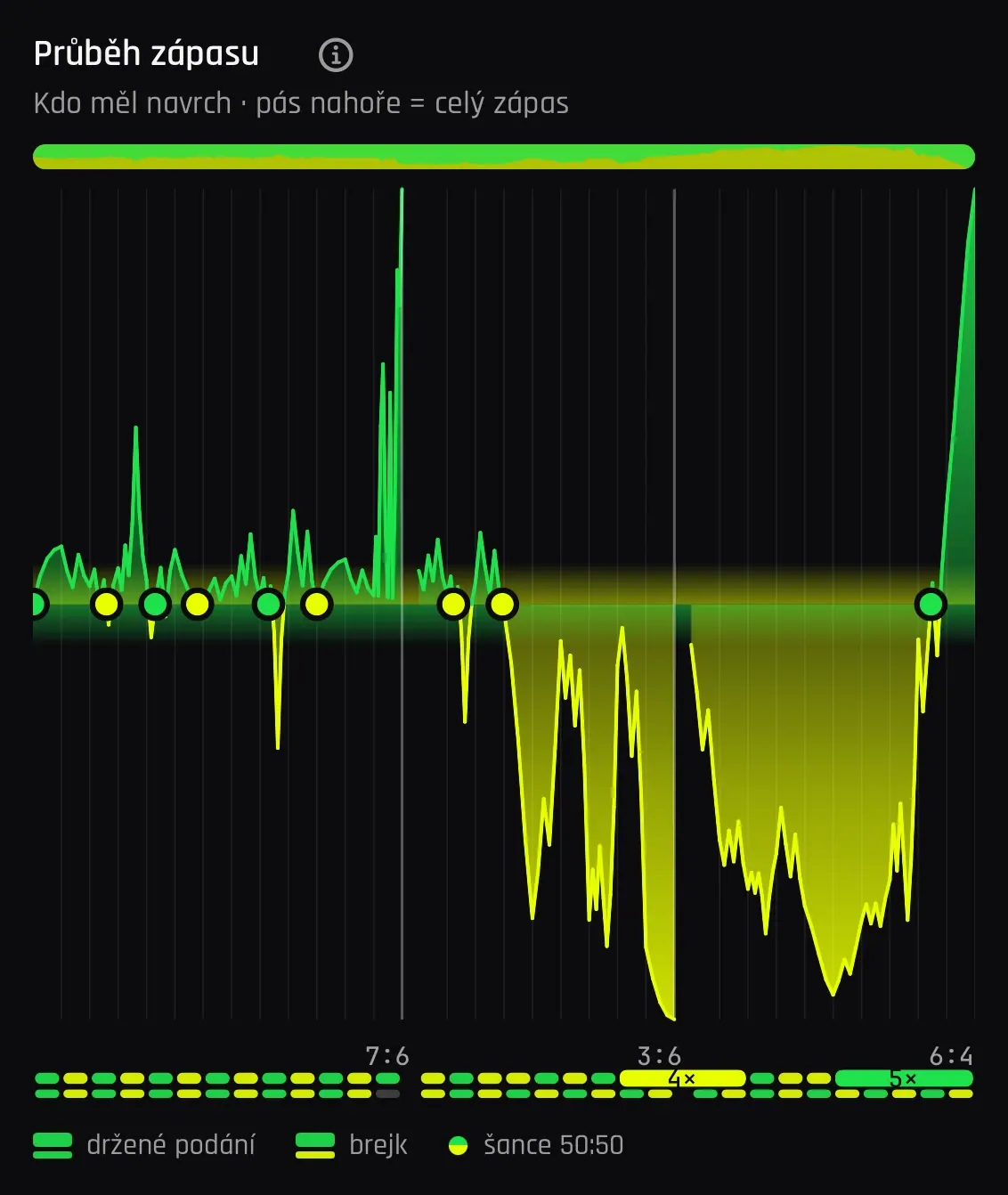
The DOTTA app shows the course of a match as a chance of winning, not as a difference in points.
Frequently asked questions
Is there momentum in tennis?
Yes, but a small one. According to the Wimbledon study from 1992 to 1995, winning a point raises the chance of winning the next one. The authors also write that deviations from independent points are small, and a model without them works as a good estimate.
Does a run of games prove the match has turned?
No. Even with a fair coin, a run of six identical results shows up in a hundred flips almost every time. The alternating serve turns random results into regular patterns.
Can the player who won fewer points win the match?
Yes. Games and sets are counted by games, not by points. In the example above, A wins the set 6-4 while B wins the points 28-24.
Does the Wimbledon study also apply to padel?
We don't know. The authors studied grass-court tennis. No comparable study for padel is known.
Quick poll
Do you believe in momentum in a match?
- Yes, I feel it
- A little
- It's just chance
One click is enough.
DOTTA keeps score for you and calls it out loud
Win the rally, click the remote on your racket. The app tracks points, games and ends, and announces the score to the whole court.